Architecting a Quick Commerce Layer on Shopify: A Technical Integration Blueprint
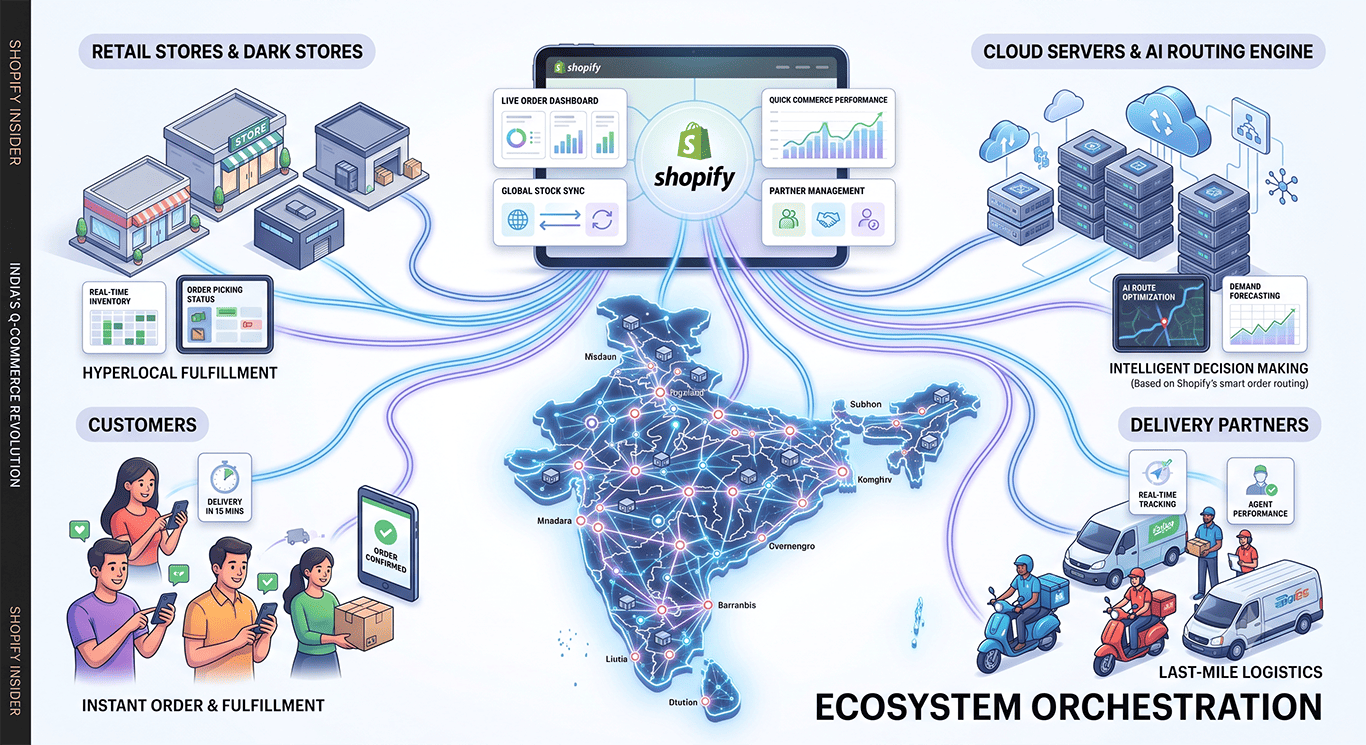
The transition of quick commerce from a niche impulse channel to a foundational retail infrastructure demands a severe re-evaluation of standard fulfillment architectures. With the quick commerce sector’s GMV estimated to breach the $10 billion to $11.5 billion mark in early 2026, bolting a hyper-local delivery mechanism onto a legacy system requires precision.
For an organization already operating a mature omnichannel fulfillment model across hundreds of physical stores via a centralized EBOS (Enterprise Back Office System), building a parallel stack for quick commerce is a bad idea. The efficient path is layering quick commerce on top of the existing infrastructure, manipulating fulfillment SLAs based on location data rather than reinventing the entire supply chain.
Here is a concrete teardown of how to construct a scalable quick commerce routing and delivery system using a native Shopify storefront, custom routing apps, and logistic aggregators.
1. System Architecture: Decoupling the GUI and EBOS
The baseline is a pan-India EBOS that handles standard omnichannel routing (same-day and next-day delivery). The quick commerce layer operates purely as an accelerated SLA node within this existing network.
- The Presentation Layer (GUI): The storefront is built natively on Shopify. Logic is embedded into the product display page (PDP) and checkout to dynamically display a “Quick Delivery” badge.
- Trigger Mechanism: This UI flag is governed entirely by the customer’s pincode. If the session pincode maps to an active dark store or accelerated node, the high-speed SLA is exposed.
- Inventory Synchronization: High-velocity stock movements require a lightweight, abstracted inventory mechanism that runs asynchronously from the primary EBOS batch updates. This prevents API throttling and ensures front-end availability aligns with hyper-local node stock.
Do not attempt to replace your core ERP or EBOS to accommodate quick commerce. Treat quick commerce as an orchestration overlay, not a structural foundation replacement.
2. The Routing Engine: Overcoming Shopify’s Limitations
Shopify’s native order routing algorithms are robust for standard e-commerce but fail when subjected to the rigid constraints of micro-fulfillment. Standard routing optimizes for inventory availability across broad regions; quick commerce requires strict geographical locking.
To solve this, we bypassed the native geographic broad-strokes and built a custom Shopify routing assignment app.
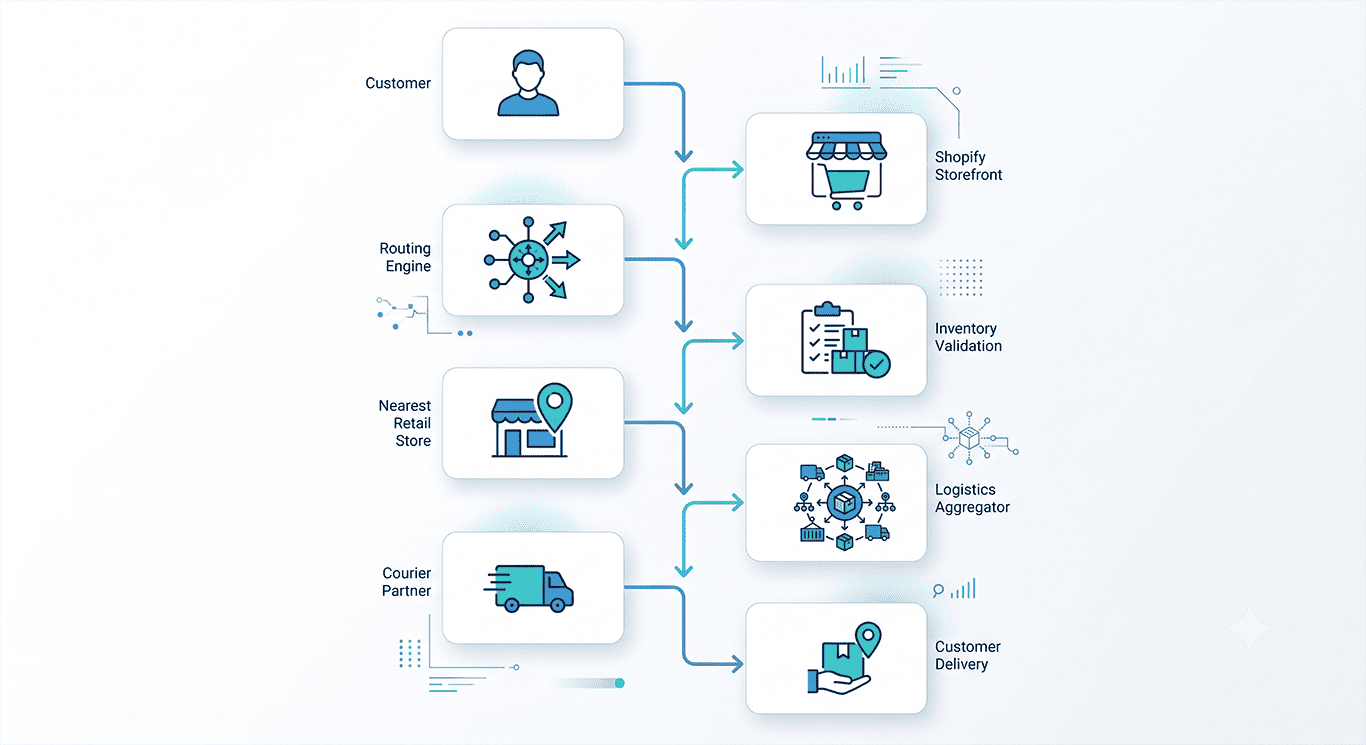
- Pincode Mapping: The custom app intercepts the order webhook.
- Node Allocation: It cross-references the destination pincode against a proprietary matrix of quick-commerce-enabled store nodes.
- Assignment Validation: If the node has the inventory and the delivery partner SLA is active, the order is routed to that specific micro-fulfillment center. If it fails, it cascades gracefully back to the standard omnichannel next-day queue.
3. Logistics & Carrier Integration: Aggregation vs. Direct API
Building direct integrations with multiple hyper-local carriers is a maintenance liability. API changes, downtime, and scaling to new regions introduce unnecessary technical debt.
The architecture utilizes Clickpost as a logistics aggregator. This single integration point handles carrier allocation, tracking, and failover states.
- Execution Partners: Integrations with Blitz and Borzo handle the physical last mile. These carriers provide phenomenal setup speed and reliable SLAs for hyper-local drops.
- Failover Logic: If one carrier experiences a regional outage, the aggregator automatically defaults to the secondary partner, ensuring the 10-to-30-minute delivery window is preserved without manual intervention.
Utilizing a logistics aggregator reduces your engineering maintenance burden. You trade a marginal per-label fee for vastly superior uptime and immediate access to new regional carriers.
4. Phase 2: GPS Coordinate Routing and The HLD SLA
Pincode-based routing is a viable MVP, but it is fundamentally flawed at scale. Pincodes in India cover erratic geographic areas, meaning a node might be 1 km away structurally but require a 5 km transit due to road layouts.
The Phase 2 Architecture mandates GPS coordinate-based routing.
Hyper Local Delivery (HLD) partners require exact drop and pickup coordinates to bypass traffic choke points and guarantee efficiency. The custom routing app will ingest geolocation APIs at checkout, mapping the exact Cartesian distance to the nearest node rather than relying on arbitrary postal boundaries.
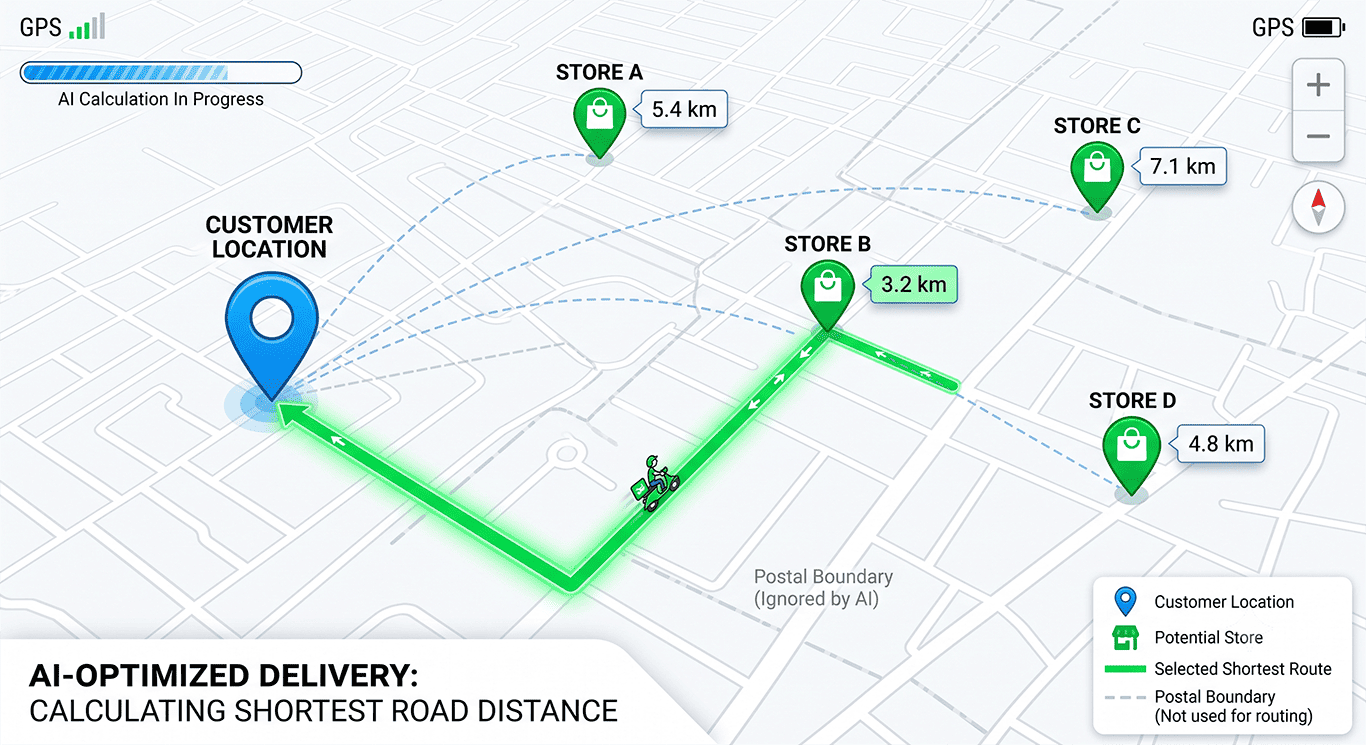
Pincode routing will eventually cause SLA breaches as order volume scales. Treat it strictly as a Phase 1 pilot strategy.
5. Strategic Trade-offs: Why Build This?
Deploying a quick commerce layer when standard logistics (same-day/next-day) are already stable is an exercise in strategic experimentation. For a growing brand with a standardized supply chain, shifting to a 30-minute SLA is not strictly necessary for standard apparel categories.
However, the infrastructure becomes a distinct competitive moat when introducing high-urgency categories.
| Strategy | Execution Logic | Financial Impact |
|---|---|---|
| High-Urgency Essentials | Deploying quick commerce for categories like baby diapers, where new parents face severe time scarcity and stress. | Secures high repeat purchase rates and strong brand loyalty early in the customer lifecycle. |
| Gifting & Bundles | Utilizing quick commerce for last-minute gifting or comprehensive kits (e.g., Hospital Bags). | High-AOV bundles easily absorb steep hyper-local fulfillment costs and preserve contribution margins. |
| Pilot Mindset | Launching the Q-commerce layer as an experiment before fully committing working capital to dark store inventory. | Prevents high expiry risks and margin leakage on low-velocity SKUs. |
Failing to establish a quick commerce footprint for these categories risks losing market share to platforms that have successfully conditioned consumers to expect instant gratification. By building this routing engine now, the supply chain is prepared to seamlessly integrate full-fledged quick delivery categories in Phase 2, maintaining control over the customer experience while leveraging existing retail infrastructure.